The Texas Leak Detection Guide
How Do Pros Find A Hidden Leak In A Texas Home?
A professional visit follows a set order: confirm, isolate, pinpoint, document. The pro first confirms water is really escaping — usually with the water meter — then isolates sections of the system so whole branches are cleared or confirmed one by one. Only then do the listening and imaging tools come out, because they work best on a narrowed search area. In Texas that order matters, because expansive clay soil and limestone ground can hide a leak deep below the surface where no stain ever shows. The visit ends with a marked location and a written record you can hand to any repair crew or insurer.
What Happens First: The Meter And Pressure Tests?
The water meter test is simple and decisive: with everything off, movement means loss. Pressure testing then raises or holds pressure in one section at a time — hot side, cold side, irrigation, pool — using a gauge to watch for decay. A section that cannot hold pressure holds the leak. This isolation step is what keeps the search honest: instead of scanning a whole house, the pro tests a map of the system piece by piece. The same visit usually maps damp with a moisture meter, so the report shows both the source and the spread — and every homeowner should know where the main shut-off valve is before they ever need it.
How Do Acoustic And Thermal Tools Pinpoint The Spot?
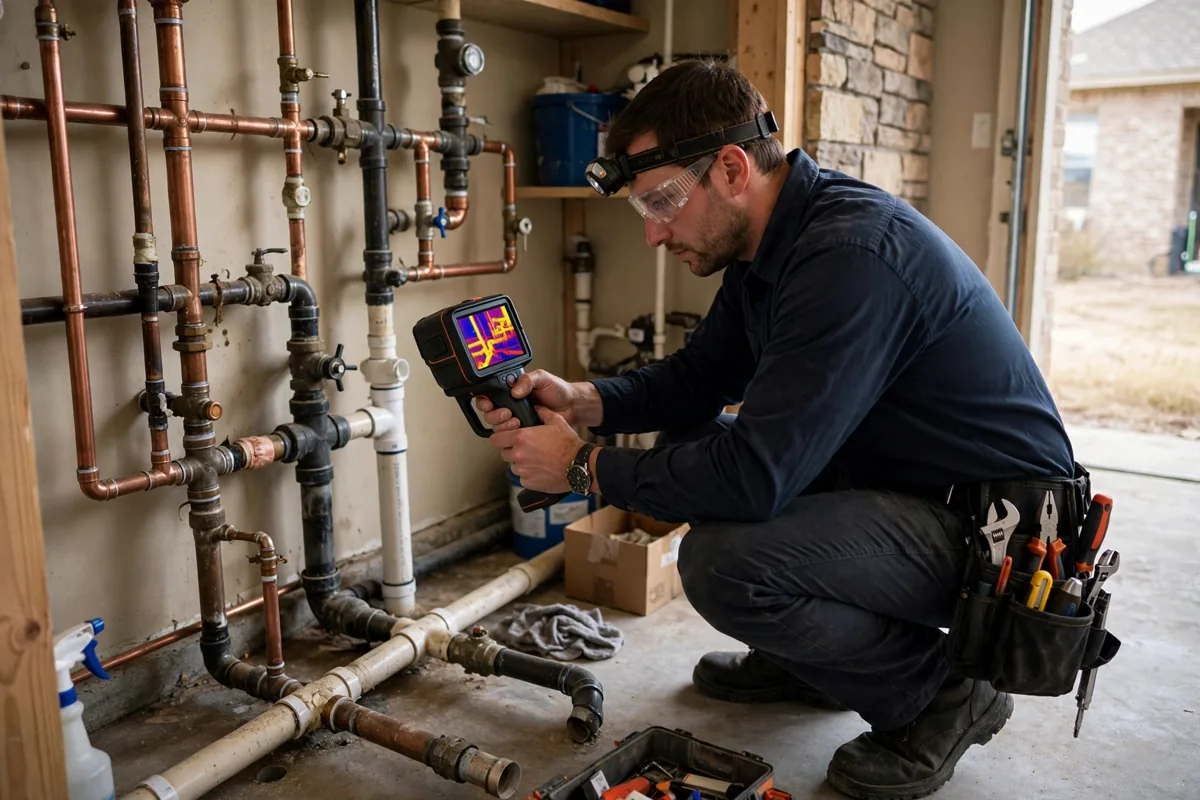
Water escaping a pressurized line makes a distinct sound that travels through pipe and soil. A ground microphone and acoustic listening equipment let the pro follow that sound to its loudest point. A thermal imaging camera (FLIR) shows the warm path of a hot-water line under flooring, often revealing exactly where it spreads. In limestone ground, sound travels differently through rock than through clay, so the pro adjusts the search pattern to the ground under your home. Correlation loggers help on the long runs between meter and house that are common on larger Texas lots.
The wettest spot is often not the source — water travels along pipes, beams and soil before it shows.

Why Do Texas Pipes Leak?
Texas housing is the newest we serve — a median year built of 1992, with 33.2% of homes built before 1980 (U.S. Census Bureau, ACS 2024) — yet Texas pros stay busy, because the ground and the weather work on pipes from both ends: soil movement all year, and hard freezes in a climate that rarely insulates for them. Understanding the likely failure in your home's setting tells the pro where to start listening.
What Happens To Copper And Plastic Lines As They Age?
Copper develops pinhole leaks where water chemistry is aggressive, and plastic lines can split at fittings or where shifting soil flexes a rigid run. Texas water supplies vary widely, and the U.S. Geological Survey places parts of the state in its hardest water patterns. Water chemistry ties many failures together: hard water leaves mineral scale inside lines and raises pressure on joints, acidic water can eat into metal over time, and soil corrosion attacks buried pipe from the outside where soil stays damp against the line.
How Do Clay Soil And Limestone Stress Underground Lines?
These Texas regional risks start underground. Expansive clay soil swells when it rains and shrinks in dry heat, and that shifting soil and foundation movement bend lines under the concrete slab a little at a time, season after season, until a joint or a worn section cracks. Limestone adds a second problem: rock seams and voids let support shift, and escaping water can travel along a seam instead of surfacing above the break. In a warm climate built for heat, freeze bursts then finish what movement started, splitting lines that were already stressed.
Tip: Note the meter reading before you call. One reading, taken with everything off, tells the pro more than ten minutes of description.
Want A Pro To Run These Tests At Your Home?
One free call connects you with a local pro who can typically arrive in 30–60 minutes.
📞 Call Free — (800) 555-0100What Should A Texas Homeowner Do With The Report?
The detection report is the bridge between finding the leak and fixing it well. It records the leak's location, the tests used, photos or thermal images, and moisture readings. Repair pros quote more accurately from a report than from a description, and insurers use the same documentation to judge a claim. Keep it with your home records — if a second leak ever appears, the map of your lines in the first report speeds up the second search. The options usually mean a spot repair through the smallest practical opening, rerouting a line around the failed run so the old section can be abandoned in place, or repiping the affected section when the pipe is failing in more than one place — and the pro prices each one before you choose. The same report also supports a water-bill adjustment request to your city water utility after a repaired leak. Seasonal prevention checks matter in Texas: freeze preparation before a forecast cold snap and a spring irrigation check when systems restart. NOAA station data put the Texas freeze-day mean at 45.3 days a year, concentrated in the north and the Panhandle, and lines in a warm climate often run through attics with little insulation — which is why one cold snap can split several pipes, and why the leak appears only when the pipe thaws.
Which Pipe Materials Fill Texas Homes?
A Texas pro reads the home's era in its pipes. A copper pipe system from the 1970s and 1980s can open a pinhole leak as it ages; a galvanized steel pipe from earlier decades corrodes inward until a joint weeps; cast iron pipe carries drains in older homes and cracks as it ages. Newer construction and remodels use PEX pipe and CPVC pipe, which resist corrosion but can still fail at fittings, some 1990s and 2000s homes carry the Kitec plumbing system whose brass fittings are known for failing as they age, and a water heater at the end of its life is its own leak source. Pipe corrosion, hard water scale inside lines, clay soil movement under slabs and the freeze burst after a cold snap complete the state's usual suspect list — the pro tests in that order.
Why Does The Material Change The Search?
Each material carries sound and heat differently, so the same acoustic listening approach is tuned differently for copper than for plastic. Thermal imaging reads a hot line under a floor clearly regardless of material, while tracer gas helps most on long or complex runs. Knowing the material narrows the settings, the search pattern and the likely failure points before the first test begins. Pipe materials and how each fails also shape the repair conversation, because a failed run in one material often argues for rerouting in another. Three state bodies matter in this work: the Texas State Board of Plumbing Examiners (TSBPE) handles licensing for plumbers, the Texas Commission on Environmental Quality (TCEQ) oversees public drinking water systems, and the Texas Department of Insurance (TDI) publishes guidance on water-damage claims. Licensing and permits questions are settled with the state licensing boards and your local building department before anyone is hired, not after — local permits for repair work vary by city and by the scope of the job.